
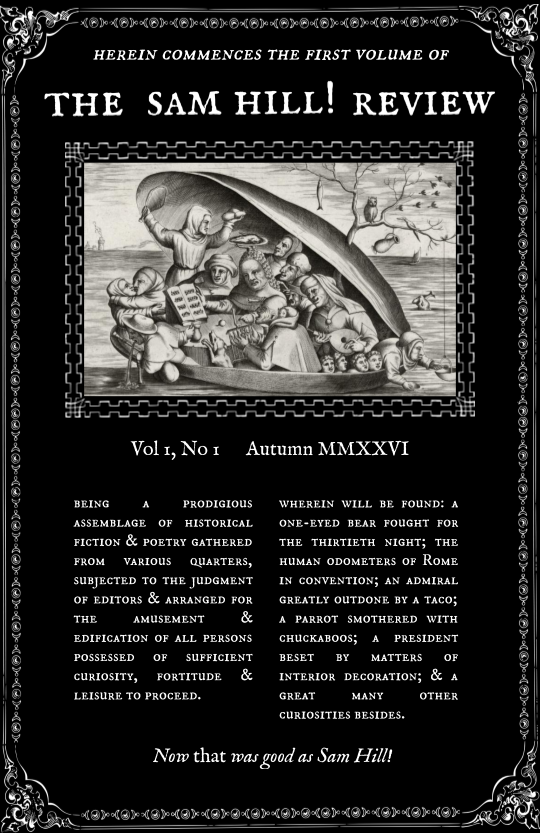
The Sam Hill! Review publishes historical fiction & poetry that makes you say: “now that was good as SAM HILL!”
Somebody made off with historical fiction & left the indie lit mags holding an empty bag. WHAT IN THE SAM HILL?! We want it back. We want wild, funny, gorgeous, difficult, irreverent work that smashes the museum display case.
Send us the past with the dust still on it. Send us the faces the microfilm reader washed out & mangled. Send us the voices nobody bothered to transcribe. History was never told in one voice, & neither is this journal: we especially want work from writers who’ve been historically in the margins — BIPOC, LGBTQIA+, older, disabled, & neurodivergent writers, & anyone whose angle on the past we haven’t heard yet.
Return to ContentsSteve Kemple is a teacher, writer, & former librarian. His story about a cow placed third in the “What the Wild Carries” prize for short fiction in Uncharted Magazine (forthcoming). He is working on his first novel, about a family of con artists, set in 1850s Ohio. He received an MLIS from Kent State University & a BFA from the Art Academy of Cincinnati. Rumors that he lives in New Jersey have been greatly exaggerated.
Dr. Kathleen Kidder is a professor of classics at Seton Hall University & author of Criteria of Truth: Representations of Truth and Falsehood in Hellenistic Poetry (Harvard Press, 2023). She received a BA from the University of Texas at Austin & a PhD from the University of Cincinnati. She has published articles on the Sirens, Helen of Troy, Demeter, & Proteus. Currently she is exploring depictions of geographic & architectural space in Lycophron’s Alexandra.
We want flash, short fiction, & poetry that feels lived in, not visited. If you spent three hours reading about Bronze Age bread ovens just to understand why your character complains about the food, or if you read someone’s dissertation on Victorian sewer systems to better grasp the source of conflict in your 900-word story, then you’re our kind of writer.
What we’re not after is costume drama. We don’t want stories that treat the past as set dressing for a plot that only makes sense in 2026. We want prose & poems that inhabit the past & send up something that makes sense to a contemporary reader.
Beyond that, we’re easy: whatever era, whatever form, whatever degree of fidelity to the historical record. Just make it good as SAM HILL.
Click here to learn about our featured call!
Formatting: .doc, .docx, .rtf, .pdf, or .txt. Times New Roman 12 pt (or Papyrus, if you dare). Include your name & email at the top of the first page.
While we don’t accept submissions by mail, we would almost certainly make an exception for manuscripts written on cuneiform tablets or papyri.
Any era, any place, but flash. We’re open to micro (under 400) or flash (400-1000). Give us a small window onto a large century. We’d love to see an entire civilization from the perspective of a rock or a pinhole camera. Bring us the past at close range — a single object, a single voice, a single thing gone wrong — & trust us to feel the rest of the world pressing in around it. We’re also interested in reviving the art of short, absurd quips that appeared as page filler in 19th century newspapers. More on that later!
Any era, any place, up to 3,000 words. If you have something longer, we might consider it. Novel excerpts are welcome if they stand on their own. We’re open to anything, but especially interested in stories with undeniable voice that inhabits the language of its time and place. Give us a voice the that’s immediately legible — or one the reader has to do a little bit of work to hear. Think Paul Kingsnorth’s The Wake.
Send up to three poems in one document. Any form: received forms, free verse, prose poems, & whatever you’re building that doesn’t have a name yet. We’re drawn to poems that know one specific thing — a trade route, a tool, a grievance — & decline to explain it to us.
SPEAK, MEMORY, and make it good as SAM HILL! One poem that tells something. Ballads, chronicles, epics with the middle missing, verse that reads like testimony. Go big or go HOMERIC.
For our inaugural call for submissions, we’re looking for short fiction & poetry where the setting matches the word count.
Here’s how it works. Pick any one year between 1000–400 BCE or from 400–1000 CE. That’s the year your story or poem should somehow engage with. It’s also your exact word count. For example: a story set in 612 BCE should be exactly 612 words. A poem about the year 868 CE will be precisely 868 words.
No rounding, no mercy, & yes, we count. Some years we’d be glad to see:
Or choose some other year. Major historical events don’t need to be central to your piece, or even mentioned. Give us the ordinary day, the rumor going around, the aftermath of something that happened three villages over, the thing nobody bothered to write down. The year is a setting, not a subject.
Original & previously unpublished. Send .doc, .docx, .rtf, or .pdf; Times New Roman 12, double spaced; your name & email at the top of the first page.
We wouldn’t not accept cuneiform tablets or handwritten papyri.
In your cover letter, tell us your year & whatever history fed the piece (your Cool History Thing). Sources are welcome, but exhaustive detail is not required.