Ambrose Fells twitched his mustache and worked the crowd. “Now, most of you good people know about Annie Edson Taylor, the first woman to successfully go over Niagara Falls. In 1901, Taylor chose the Horseshoe Falls side which, at eighty feet high, is tougher, certainly, than the sixty-foot drop of Bridal Veil Falls. She exited her custom-fitted pickle barrel, cut and concussed, after seventeen minutes. Bravo. I’ve spoken with the lady, and I’ll share this little titbit with you all: the woman is undeniably brave, still attempting to promenade her bold feat in company of high society. Alas, the poor creature has no idea that she remains in full possession of the briny-piquant odeur of dill.” The crowd—all men, with the exception of Mrs. Ambrose Fells, laughed along with the winking Ambrose. Reporters scratched away in their notebooks as the honeymooners and tourists applauded.
Ambrose, standing aboard the boat that would haul him and his craft out into the middle of the Niagara River, continued his pre-plunge harangue and hucksterism. His barrel-vessel stood empty to one side, while in front of him on the dock, included in the attention and honor, stood a smiling blue-eyed boy he’d found the day before, exiting the back door of a church during services; he had, on the spot, recruited the child into his service. Ambrose explained the hire, complimenting his wife’s beauty and telling her that she did not have “the beseeching face necessary to garner contributions from the tightfisted pockets of the throng.” The boy carried a hat for passing, wearing an affected look of innocence and imploring.
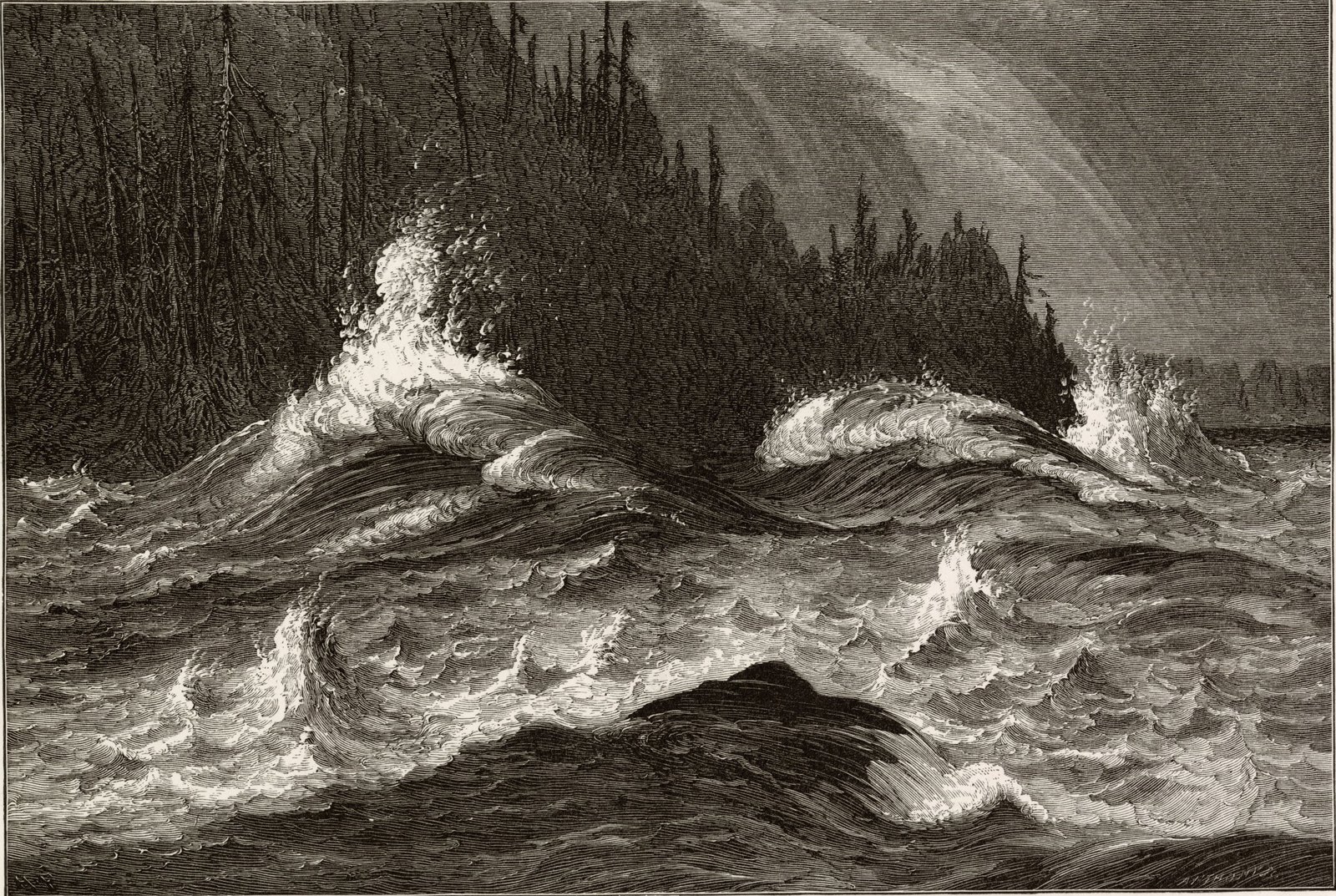
People continued joining the gathering, attending Ambrose’s powerful oration. “I wish to take nothing away from Miss Taylor, mind you, but here, two years after her marinated tumble amongst the downy pillows of garlic and pickling salt, I stand before you: clean, energized, and ready—Ambrose Fells, Daredevil Extraordinaire! I must admit: I will not be the first to go over Niagara’s third set of falls,” his hand rose to present the gigantic cataract roaring and misting at the sky-ending of the river, “these, the superior force, the eight-hundred-and-thirty foot aptly named American Falls. That dubious, first-over distinction belongs to one Joseph Avery, as well as a couple of other fellows of shadowy and dubious achievement. But I part ways with those predecessors, inasmuch as I shall be the first man to triumphantly go over and live to tell the tale!” A murmur of laughter chuckled through the onlookers; most of them were raised-eyebrows amused by such optimism, while others passed money—they appeared to be betting-men with grave and grinning doubt. Not a one of them had ever seen a drowned body before, and most were certain that this stunt would end badly, broken, and wet.
The audience swelled to forty-four people, comprised mostly of reporters and tourists, arranging themselves in a semi-circle around the boy on the dock. Ambrose paused, patting his hand against his specialized barrel. Keen interest in the goings-on had been well-built, in all but one; Katrina Fells covered her mouth so that her yawn might not be so public. She’d listened to the Niagara Falls history lesson a thousand thousand times already, and the details and subject bored her to tears. Katrina noted to herself that Ambrose avoided talking about the lavish cushioning, straps, compressed air and ballast—he’d taken expensive pains to make sure that he might have a more comfortable ride than the pickled Taylor with her pillows and anvil. Those pains had come at the expense of their paltry bank account and her father’s business.
Sullivan Cooper, Katrina’s father, stood stoically by her side. Both hands gripped tightly at his leather suspenders, their knuckles near-white. He listened as Ambrose nattered about the barrel—his modus of transit to another realm—that Cooper had constructed especially for him. But as the prelude continued, offering exaggerated details of the barrel’s ingenious design, Cooper’s contributions remained anonymous. Ambrose claimed exclusive inventiveness of the design, asserting that his feat and creation would serve as an inspiration, once he emerged—a modern-day Jonah, swallowed and taken to the depths of human endurance before joining the sun-lit world once again. He promised to emerge from the tumultuous baptism of Niagara, able to relate his near-death experience in terms of actual experience. Sullivan Cooper, having heard all of his son-in-law’s prattle before, found nothing new there other than furtherance of his antipathy for the boastful young man. His disappointment and annoyance for the fate of his hoodwinked daughter had placed them all in something of a pickle.
There were no thanks for the barrel maker, no thanks for the boatmen with boathooks—barrel hooks, in this case—waiting below in the Maid of the Mist pool which drank lustily from Canadian and American springs and seasonal rains. No thanks were given to Burt Peakers who, once Ambrose entered the barrel, would work the bicycle pump, pushing compressed air into the barrel and stobbing it before the launch. No thanks for the captain and his crew who would tow the barreled Ambrose to an arranged spot in the Niagara River before releasing the line. There weren’t even any thanks to God. All weight and glory were borne by Ambrose’s shoulders.
Once the signal dropped for the boy to begin circulating—Ambrose asked for the small crowd’s monetary indulgence, saying the donations would go to either his world tour or to his funeral—Sullivan Cooper took his daughter by the elbow and steered her toward the causeway that might provide the best view of the actual point-of-no-return. The walk would involve effort and a short amount of time; but then, so would Peakers’ hand-pumping.
Sullivan Cooper spoke low to his daughter as they walked; he passed her a red velvet bag cinched at its drawstring throat. The plump bag clinked with coin; there was also a rustle, as of paper. “Here, daughter. A good part of my savings has been sunk into that barrel that your husband cocoons himself within, but I’ve been setting this aside for you since the day you were born. God bless your arrival, dear Katrina. Would that your mother had lived to see you grow from child to woman.”
Katrina did not quite understand. “Papa, we’ve lived a modest life, with little money to spare. Ambrose agreed to marry me, accepting of the impoverished fact that there would be no dowry—and now you give me this?” Katrina felt occasional pangs of shame for living within small means, even as Ambrose spoke incessantly of future wealth and achievement, if only he could make the world rotate to his whim. She’d spoken to her absent mother in her prayers, but expected nothing more than what each new day might bring. Katrina knew: her father had obliged Ambrose, importing expensive French oak for the barrel staves. The nails, the galvanized headers and hoops, the curvature of the bilge and the bungs—Ambrose raged over materials and design perfection. Cooper had stayed mum, and had accommodated.
He pushed the money into his daughter’s hands. “I saw the man as a ne’er-do-well from the moment I met him. I could wish you’d had more prospects, but that’s…water over the falls, I suppose. This…stunt. It is the contrivance of a vain man who doesn’t care to work for a living. We have both been taken in by this self-aggrandizing braggart. He has shown nothing but disrespect—for you, for me, for his fellow man. Could I have provided a dowry at the time, could I have put money into a wedding spectacle?” The old man’s eyes misted. “I have deceived you, daughter, for the answer is yes. The whiskey business is good, and thus the barrel business is good. I’ve kept the money aside, remained silent, assisted your husband in his schemes, all the time waiting to see how this marriage would proceed.”
The crowd noise trundled after them—apparently Ambrose had entered his barrel. Someone shouted out new odds, inciting bets. The waiting boat strained at its ropes, prepared to head out, to fight current as it placed Ambrose Fells, Daredevil Extraordinaire, in the spot of his own choosing, the one he’d dictated would serve best for safe passage down the waterfalls.
Cooper looked around to make sure no one remained within hearing distance. “You will take this money, buy passage to California. You will change your name, begin a new life.”
The boy with the hat came racing up to the two of them. “A gift for the brave man?” he asked. Cheeky, asking family—but then, his cut of the take came as a percentage.
“The brave man? The one we told to choose a safer pathway closer to shore? Sorry, boy, we’ve already given. Go away.” Katrina waved the boy off, returning her attention to her father once the boy stuck his tongue out and retreated. “I don’t understand a bit of this, Papa.”
The old man rubbed a hand along his greying chin whiskers, feeling their brittleness. “Your husband chided my work, time and again, insisting upon excellence, precision, all in the name of this…whatever this is. Ambrose felt entitled to his wife’s father’s contributions, insisting that he would create a grand life for his spouse that would soon be filled with fame and riches. Oh my dear girl, it’s but another scheme, more words added to the same old stories, one more fantastic venture bound to end in abject failure.”
The old man’s hand raised, one finger pointing to a heaven that rarely looked down upon them with kindness. “To be fair, Ambrose finally surprised me with this newest stunt. He actually told me, once I completed his Niagara barrel, that she was beautiful, the mark of perfection—something he’d never seen before.”
Katrina bowed her head. The two continued speaking, even as they felt the urgency in the approaching steps behind them. Everyone would soon be elbowing for the best viewing spots.
“I gave him what he demanded, and more. I imagine that the fanatical Burt Peakers has pumped himself silly, pushing compressed air into the barrel using the bicycle pump I purchased for this feat of derring-do. Burt is half-deaf, so he probably didn’t hear the glass vials of chloroform break with the first stroke—the ones I placed inside the compression chamber of the pump.”
Katrina’s button-boots stopped in place along the causeway; she found herself in a fog, staring at her father. “Chloroform, Papa? To what end?” A fine, cool glazing of spray, carried by light swirls of wind, cast a shimmer over them.
“Ambrose will inhale the sweet smell of chlorinated lime. But to put things to rights, I advanced the plans further. The chloroform is simply the backup design. If the ether—which I’ve sealed with wax inside of glass Christmas balls—if that doesn’t find audacious escapade while swimming the currents of his central nervous system, then the chloroform will find its own gamble and way. I imagine those brightly colored decorations, tucked into the corners of various feather pillows, will break upon impact at the bottom of the falls. There’s quite a few rocks in the roiling spin down there.”
“Oh Papa. What have you done?” Katrina glanced at the hurrying water, the Niagara River speeding up insistently beside her. The crowd grew boisterous, with cheers and raised hands shaking paper money. The rush and turbulence grew into a flooding madness as they all made their way toward the plunge. She felt a tremble speeding through her entire body.
“Not to worry, dear daughter. The bungs won’t hold for that bunghole of a man—nor will the rivets. I am a master of my craft, no matter what an empty voice of the past has said about my art. By design, the barrel will spring apart in the violence of the waterfall’s thundering hydraulics. Upon its return to the river boat, I will retrieve my expensive bicycle pump. No need for it to serve as memorabilia from The Extraordinary Spectacle of Niagara.” Sullivan Cooper hugged his daughter. “Better days are ahead of you, dearest, rising in the West.”
A man identifying himself as a reporter for the Lewiston Telegraph approached Katrina and her father. “If you’ll excuse me, ma’am? Are you the wife of Ambrose Fells? Could I trouble you for a statement on just how you feel at this moment?” The reporter’s arm extended, pointing at the river. Ambrose’s barrel, loosed, now neared the edge.
The spectators leaned and bent themselves against an iron containment railing, hungry with expectations of what could happen. She glanced along with them as the barrel catapulted over, beginning its descent along the face. She’d been told, innumerable times: the dangers came at one in multiple ways, with rapid acceleration and deceleration, depending upon how the waters took you and bounced you; the chance of concussion was strong, even with cushioning. But after the fall, rocks and currents would be the next challenge, followed by any potential failure to rescue the barrel before its air ran out. Plus, there were always intangibles to contend with.
The woman touched the arm of the old man in suspenders. “Entombed. Not cocooned. We must correct mistakes—mother’s favorite saying is something precious that you’ve instilled in me on her behalf, Papa. Thank you.” She kissed the old man’s cheek, and turned her attention upon the man with the notepad.
“I’m sorry, you have me mistaken for someone else. How lovely it is here, in view of my namesake—God the Father be praised.” She smiled at the reporter, her gaze serene. “My name’s Niagara, by the way—the Maid of the Mist. And how do I feel this fine day? Thank you for asking. I feel free.”