
Macy Douglass tapped the rim of his teacup with a spoon and looked out the kitchen window of his modest Mississippi home at nothing in particular. His wife buzzed about him in clouds of perfume and powder. It was French perfume, a name neither Macy nor his wife could pronounce. He hated the way the perfume clotted around the room, giving the air a foreign unctuousness and masking the otherwise unique and homey smell of his wife’s skin.
“Mr. Cole was killed at Chancellorsville,” Maisey announced from the bedroom, “such a brave, brave man, willing to die for Mississippi like that. Ain’t that just what every southern woman wants?”
A newspaper lay on the kitchen table. A whole column of dead names, soon to be forgotten. She knows I’ve seen it, he thought, only wants to needle me.
“Why don’t you ask Mrs. Cole what she thinks of her husband’s bravery?” Macy rejoined.
“Some things are worth dying for.”
He thought war brought out the worst in people. In peacetime there were no lines of youth eager to sign up for the slaughterhouse of cannons and sawn limbs, no soldiers in your town coming by asking for the prime cuts and freshest cream. At first he believed it, the South’s struggle against tyranny, noble preservers of the Constitution. Now, having been denied twice from enlisting due to his eyesight and the whole town thrown into worship for the garrisoned army, he wished for the war to end under any amount of ignominy.
“Where are you off to?” Macy asked.
“Mrs. Hopkins and I baked some cakes for the soldiers. We’re going to bring them to the garrison on Graveyard Road.”
“Why you need all that get-up?”
Macy’s wife paused before him and unfolded her fan. “The soldiers ought to know what they’re fighting for.”
With a flourish of the fan, she departed into the silky morning. Macy thought about the first thirteen months of their marriage. That was before the war, when times had been simple, mornings spent in each other’s arms, afternoons walking down by the pallid mirror of the river, no expectation that he should be elsewhere, that his body should be used for anything other than what he wanted.
A volley of rifle fire startled Macy out of this meditation. He ducked from the windows. The rifle fire sounded like it was coming from over the hill. He squatted under the table and reached up over the edge, pushing his palm across the boards until his fingertips struck the frames. He pinched, caught nothing, and the glasses slid off the edge and shattered. “Goddammit.” He reached for the glasses. Another volley of shots rang out, and his hand lurched, plunging his fingers into the jagged orifices of the lenses. “Hellfire!” He brought his hand close and saw the blurred fleshy star with streaks of red running down the fingers. He took a deep breath. The enemy lines were in the far north of Vicksburg. He was in no danger. Yes, he should have been used to it by now. But Maisey—gone to the garrison, a sure target for Union advances. He ran out in his white shirt and suspenders, down Graveyard Road, bleak-faced and functionally blind.
Clark, the Almsteads’ boy, a little thickheaded but sweet, ambled up the road at a half trot.
“Hey Macy. You hear the skirmish?”
“Course I did, Clark. I’m looking f–”
“I was hoping we’d start whoopin those yanks soon.”
“You seen Maisey? She left just before the shooting.”
“Sorry, Macy. I’ve not seen her.”
“Where you off to? Your folks safe?” Something about Clark’s innocence, his ephebic yearning for combat, diminished the danger he imagined Maisey might be in. “I think the lines are closer to y’all’s place than anyone else’s. I hear they’re taking volunteers at the garrison.”
“I went to them last week to enlist but the lieutenant said I seemed like the jumpy type. But he’ll come around. Anyway, me and a couple of other boys was gonna go to the bluffs to watch. Care to join us?”
“I gotta find Maisey first. Don’t go near the lines. And stay out of range of the cannons!”
Macy continued down Graveyard Road. At the brown outline of the fort, he slowed to catch his breath. An officer and two of his men were posted in front of the fort, eating rolls from a basket placed atop a barrel.
“Have you seen Maisey Douglass?”
“Who?”
“Maisey. My wife. She came around here about an hour before the shots started.”
“Lotta women been up here today.”
“They were bringing some confections over here for you all.”
The sergeant looked at the basket, then at Macy. Both him and his soldiers had crumbs puckering their uniforms. “Lotta women been bringing us all sorts of goods today. Who’re you?”
“I’m Macy Douglass.”
“Thought you said Macy was your wife.”
“No, she’s Maisey and I’m Macy.”
The sergeant wiped a crumb from his shirt. “Son, you ought to go by Mason. Better yet find something in the Good Book and stick to that. Least not a woman’s name.” His companions chuckled. Macy tightened his eyebrows at the three chortling gray shapes. The sergeant swallowed the roll and turned toward his men. “You boys seen this man’s wife?”
“No.”
“Can’t say that I have,” the other said.
Farther down the bastion, the smeared shape of two women sporting hats of fierce plumage stood next to a row of white structures that Macy took for tents. He walked toward them. The two women became a woman and a soldier, and the woman became his wife. His wife’s forced laughter rang out to him from thirty paces away. Her hand floated to the soldier’s shoulder, then quickly retracted when he approached. She sauntered over, holding her downy dress with both hands while her feet did a little shuffle in the dirt.
“Hi Macy.”
He wrapped her in a great bearish hug.
“My oh my, what happened to you?” she asked. “What happened to your glasses?”
“The shooting startled me. Fell right off my face. You alright?”
“I sure was frightened. I still have the jitters.”
“Who was that you were just talking to?” He cupped his hand around her waist and led her down Graveyard Road.
“Oh! That was Corporal Conway. He kept me and Mrs. Hopkins safe during the skirmish.”
“You looked to be awful friendly with him.”
“Oh, Macy. Don’t turn this into a row.” She stopped and tapped her finger to his nose. “Now we need to see about getting you some new glasses, though I’ve heard Doctor Wilkers has left for Natchez. I suppose we’ll have to try to find a fix.” She sidled up to his shoulder. “Let’s go home.”
Later that evening, his left eye framed by a lustrous new monocle, which had been purchased in town and which he imagined brought an aristocratic haphazardry to his otherwise peasant appearance, Macy watched his wife brushing her hair in long liquid strokes before the fireplace. She had been so forward with the corporal. He squinted to see her clearly with the monocled eye, and imagined seeing her through the corporal’s eyes, her reckless smiles, her eyes probably scanning his body for readings of what lay underneath. He alternated eyes. Blurred, clear, blurred. How many times had she touched the corporal’s shoulder before he arrived? How many carefully masked euphemisms passed between their lips? It was not the first time. He had assumed it would bother him less. It did not. Soon his jealousy drifted into longing, longing for those simple prewar months, knowing all the while they were gone forever, and the war’s sleights in the hearts of men and women were only ever incomplete.
He walked between the dawn dark alleys of Walnut Street, black Quaker hat pulled almost to his eyebrows, belt buckled one notch too tight on his black satin pants, eyeing the filth of the street, the empty bottles, tattered tears of cloth, unnamable brown liquids puddled in the dirt. Hiccupping came from one of the alleys where a drunkard babbled to himself. Another lost soul. So many in this war-ravaged land. He would save them all if he could. He knelt beside the man.
“Who’re you?” asked the drunkard. “I ain’t seen you before.”
“Nor I thee. I’ve just come from Tennessee.” The Preacher studied the man. “What keeps thee in such a sorry state?”
“The whole town’s gone to hell. We got half the Union Army knocking on our door. Pemberton won’t let anyone leave, especially the men.”
“And what keeps General Pemberton from enlisting thee in the defense of thy town.”
The man eyed his whiskey bottle and laughed. “Are you gonna tell on me to the garrison?”
“I would not consign a man to die for a lost town.”
“Damn right.” The man hiccupped. His eyelids hung at half mast and his face shone with sweat.
“Thy city has lost the favor of the army and the favor of God. It ails Him to see such ruinous people such as thyself.” The preacher picked up the man’s whiskey bottle and nestled it in his coat.
The drunkard reached for it, lost his balance, and fell to his side. The Preacher stood and walked on to the sounds of the drunkard fumbling through the words of Shady Grove.
Cool night air hazed over the sleepy town. Higher up, wrinkled morning clouds fanned over the smoking chimneys. The Preacher loved the privacy of the early morning. He thought it was like taking a peek behind the stage curtain to see the scene that God had set. He walked down to the waterfront to watch the languid Mississippi sliding over the banks where small bits of paper and foundered row boats sat damp and wretched. To the south, a great metallic warship crawled forth from the shadows, a line of them, iron chined beasts slugging with hardly a headlong ripple. They snaked and columned themselves with the river. One by one the shutters opened on the gun bays, and dozens of artillery pieces poked their noses into the morning air. For a moment all was silent, no movement of any fish nor fowl. It was to be the last moment of silence for 47 days. Then the noses sneezed a sulfurous smoke, and an enormous crack rang out across the town. Cannonballs shot through the air and bored themselves into buildings, shattering windows and walls, piercing through balustrades, ripping the cornices off rooftops, some caroming off the sidewalk, bouncing into the hillside and sending huge shockwaves of dirt and sod into the air. The town stumbled awake and erupted into a bedlam of screams and explosions. Mothers rushed with their children in confusion, looking for cover. The men called to each other and helped others out of the rubble until the sound of the next volley dispersed them in panic. The shrapnel burst above their heads and peppered them as they ran. Horses charged down the street and yoked to wagons that pitched into the sidewalk. Dogs ran about in whimpers.
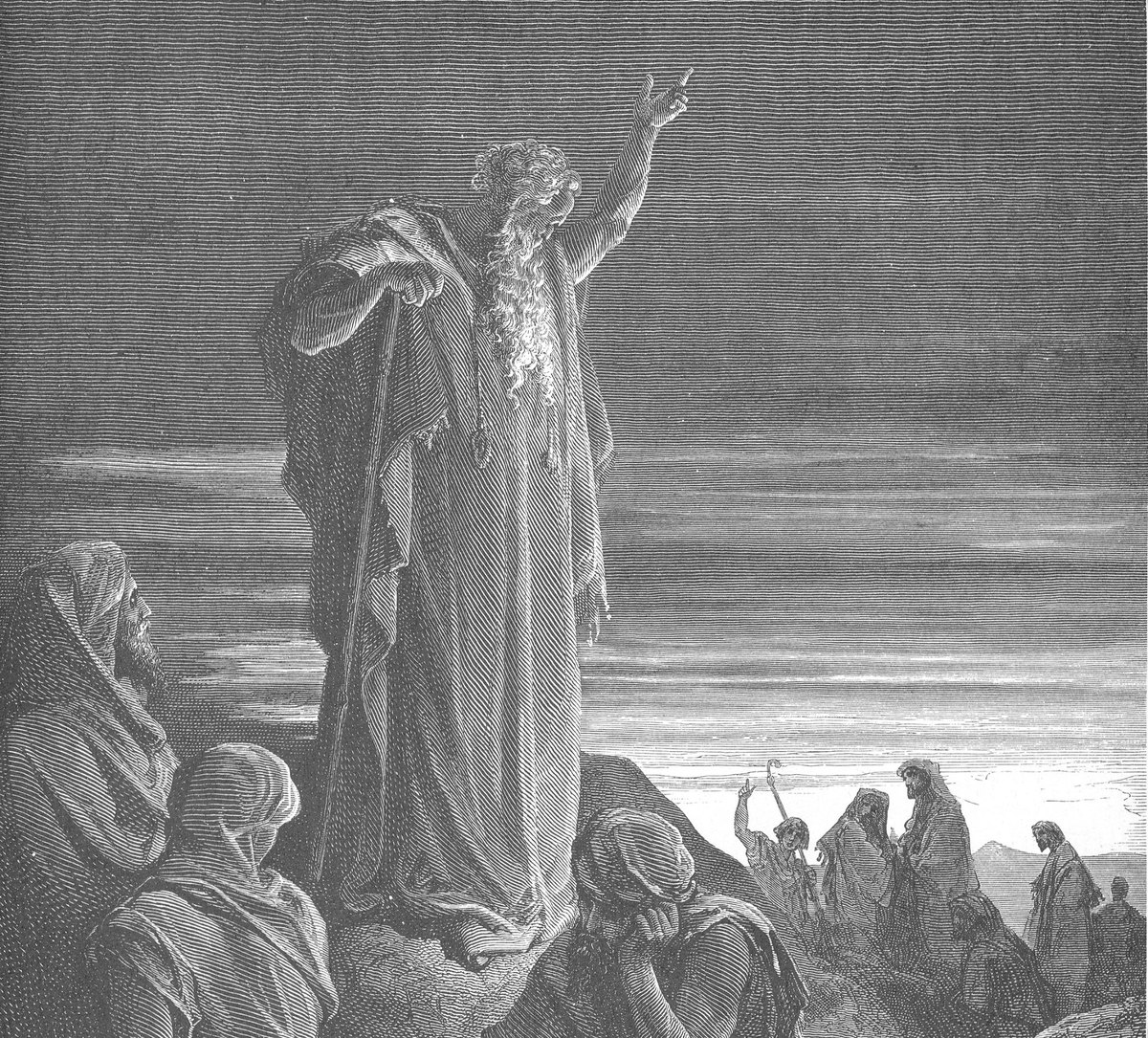
The preacher closed his eyes and inhaled a deep, primordial breath. It was the smell of gun smoke, the sound of salvation. In the midst of the unfolding chaos, he stepped upon a crate on the sidewalk and proclaimed, “People of Vicksburg, heathens spoiled by the unrighteous wealth thee use to gird yourselves with sin, harken thy ears to my word!”
The townspeople rushed about him in all directions, calling for their children and spouses, collecting keepsakes in gunny sacks, scrambling in circles in search of something solid to brace behind. Lost in the confusion, a mule blundered into the box. The preacher fell to the sidewalk. He stood, dusted himself, and strode to the end of the street, where he waited as the shells arced over the smooth face of the river and smashed into the frenzied town.
The shelling stopped at noon. Lunch time for the gun crews, or perhaps a false intimation of calm. Deafened from cannonfire, the townspeople stumbled into their strange new town. They picked through woodscrap and toppled brick in search of belongings. Loved ones. Memories. They overturned the debris of dinner parties and conversations over parlor cigars and the rubble of days and nights of youth and courtships and engagements and the old petty worries that now cooled in ash and cinder. There was no doubt now in what shape obliteration would come, a sudden hand of darkness breaking through the air and plucking out its chosen soul, and who could say where or when? They spoke to each other over the ruins, meaningless words that only palliated the unutterable fear of death at random. The preacher emerged from under the awning of a building. He stood again on the wooden crate.
“People of Vicksburg, I have a binding concern that thee has but now merely tasted the worldly dole that the Union Army designs for thee and thy town. For too long thee has prospered here on this river confluence. Thee has allowed thy souls to be usurped in splendor and commerce, let barrooms and bordellos flourish while thy insides rot in sin. Now the scales have been weighed, the ledgers tallied, and the almighty hand of God has placed thee in the light of his horrible reckoning. See how he metes out thy punishment, for the cannons are only the beginning. Thee will hunger. Thee will sicken. Thy soldiers will turn on thee, and thee will face the avarice of two savage armies. How will thee fare?”
A large crowd had gathered in front of him, frock coats ruffled, hair askew, eyes drawn in on the strange man admonishing them from a crate.
“What kind of country turns its cannons on regular folk?” a man asked to the angered affirmations from the crowd.
“It is penance, my friend, penance to be paid out across these southern states. The noose is knotted round thy town, ever shrinking. I have foreseen the destruction yet to come, and I have shored myself against it, for there is hope for me and for thee: join me in my church, and thee shall witness for thyselves the renewal and the righteousness born from this, thy desolation. Thee may think thee are safe, but I assure thee there is no hope in this town save for the everlasting light of God.”
The crowd dispersed amid a mutter of curses and dismissals for the Preacher, but one did not. Macy Douglass’ dust puckered and monocled face watched the Preacher, for he had given voice to a feeling that was in his heart all along, that the town was rotten, that each man’s soul was thick with greed and thronged on by an unquenchable lust. He had seen the town of his youth open its doors to all manner of river raffle, drunken deckhands stumbling in off the riverboats, rebel soldiers on furlough prowling about the waterfront ravenous for female souls, his wife’s especially. Yes, if there was any man that could redeem Vicksburg, it was this preacher. Macy looked up at the Preacher still standing on a wooden crate.
“It’s true what you said,” Macy offered.
“Yes, and soon it will be known to all.”
“My wife, she… she gets away from herself sometimes. She enjoys the pursuit her beauty brings.”
The preacher climbed down off the crate. “I can save both of thee, but thee must join me. We must have a meeting house, a place of quiet and atonement. The only safety will be in the caves.”
The people of Vicksburg moved through the cold breath of war that had settled over their town. It roiled into homes, shuttered their storefronts, diffused itself in leaden clouds churned thick with saltpeter and dust. Beside them in this skeletal land, the houses laid vacant, deserted without warning and darkened at the passing of their shadows. The inhabitants have departed while the uninvited guest rudely mucked about the place. Where have they gone? Round the river break, over these sun-bleached streets, down they sunk, debased and hungry, down into the upturned earth, a honeycomb of underground abodes where the bottomside roots of the trees hung like tapestry and eyeless worms wandered from room to room. There was Macy standing proudly above this excavated home. Below, Maisey straightened the easel back of the only portrait she owned of herself and placed it on an end table in a corner of the cave. She lay in her little cot and pulled the sheets above her eyes. It could almost be home if she believed it enough. Pocks of dirt fell onto her as Macy walked over the cave ceiling. He went off to dig Vicksburg’s newest church.
In the days to come Macy scampered about the streets at the behest of the Preacher, leering out at the sinful world through his one good eye. He fetched candle sticks and crosses from the deserted churches in town. Not since before the war had he brimmed with such enthusiasm. He stood on the threshold of the cave church and looked down. Below him the town, and off the hills, lines of destitutes, trains of nomads heading nowhere. Hollow eyed, they carried candelabras, armoires, chairs and cots to furnish their subterranean homes.
Always there were distant reports of gunfire, cannons depositing shells over land and sea. Ragged clumps of soldiers trickled through the streets in search of supply. In the first few weeks some of the townspeople eagerly bestowed their proud soldiers with their best viands, but the food stores grew thin. Mule and dog meat became staples. Whiskey and tobacco became more precious than jewelry, and each man did his best to hide the true amount of each that he possessed.
When the cave dwellers slept, rats darted under the cots, scraping their dusty bellies below their new cohabitants, and the spiders from their webs dangled like dream catchers while the sleepers below fixed their minds in selfish prayer for deliverance. On one of these nights Maisey arose from the cave and ambled down to the quiet waterfront to glimpse for herself the white china stars and attempted to decipher what messages might be left for her. She saw only the mute, inscrutable sky staring back at her, and she came to know the utter futility it is to seek answers or even to ask the question.
After the first four weeks, once it became clear that the siege would not be ending under any common understanding of mutual suffering but would be desperately continued by the forces of pride and attrition, Maisey stopped speaking to her husband altogether. She felt her words strain and falter, failing to carry even the faintest weight until it became easier to just wait in silence, wait without expectation or hope. During the day she slept, awakened only by the occasional easterly wind stirring the hot loamy air of the cave. The cannonades stopped bothering her. They became only another part of the waiting. She seemed to herself to be the only woman in the town without a purpose, without volition or movement at all. In her stillness, in the hours she spent staring at her eyelids coppered by incessant daylight, in the nights she spent wide-eyed tracing out the shapes and causes of the night’s manifold sounds, she came to know the strength and virtue of her patience. She came to know the face of God himself. So one day, when Macy returned from his cave church, sweat-stained and brimming with religious fantods, she rose from her bed and went to him, kissed his cheek and said, “I’m ready. I’m ready to join you all.”
The Preacher stood now, on the thirty-first day of the siege, June 15, 1863, upon an earthen altar, his head slightly tilted under the low cave ceiling and regaled his congregation with a sermon. “Friends, fear not thy smoldering death in bombardment but fear only the death of thy soul. Pray not for an end to this siege but for the siege to cleanse our hearts and minds of enmity, for the siege to expunge that spirit of prodigality and wickedness that grips the souls of this town like the hot tongs of the blacksmith. For while the living world may seem fixed on the path to destruction, know that the only peace thee shall require is the peace of thy soul. But thee will say, ‘Where is my bread, my sustenance? From whence cometh my next meal?’ And to thee I say thus: want not for bread nor spirits. Swear with me here and now not to enjoy them, nor to want for them until that day thee has been deemed fit to rejoin the living world created in the Lord’s light for good men. Let death come to the unrepentant, let the black-hearted sinners be smote for their iniquities, let the cannonballs be instruments of the Lord’s divine justice, let them splinter the bodies of the gluttons, the drunkards, the lustful who spend their days engaged in fruitless copulation…”
The Douglasses kneeled in the dirt, both smiling. Macy squeezed his wife’s hand and she squeezed his back, as if their joint grip was a further conduit for the Preacher’s words. One by one the dozen members of the congregation rose from their earthen benches and went forth to the Preacher to receive a eucharist of ship’s biscuits dipped in river water, now their only sustenance for the day. Once all returned to their seats, the Preacher gave a short benediction, and the congregation began to disperse. The Preacher stepped down toward the Douglasses and took them each by the hand.
“I am so thankful that I’ve found a flock as pious as this one,” he said.
“You– thee came to the right place at the right time,” Macy said.
Maisey nodded, only slightly fixated on the Preacher’s miraculously manicured mustache. She could not look away. It was not that he was now the tallest man in Vicksburg, nor that his appearance seemed, beyond possibility, to not be in the least affected by the battle raging mere miles from where he now stood. No, she knew it had to be something else that transfixed her. She had ascended past the mere virtue of earthly flesh.
“I just wish,” the Preacher said, taking his hands back, “I just wish that we could have a proper lectern on our altar. It is difficult to hold the Good Book in one hand without losing my place.”
“The Episcopal Church had one the last time I was in there,” Macy said. “I could fetch it over.”
“Macy, that would be an incredible labor for our church. I thank thee.” The Preacher laid his hand on Macy’s shoulder.
Macy nodded to the Preacher, repositioned his monocle and departed through the cave’s mouth. The rest of the congregation departed too and by noon Maisey and the Preacher sat at a side table with a thin candle alight between them.
“You know, Maisey, I’ve been to many towns these past two years. Many towns. Memphis, New Orleans, Birmingham. Not one of them has received me quite like yours.”
“Us Mississippians know how to receive a guest, especially one of your pedigree.”
“Yes. I really feel as though, even though all of this wretched siege, we’ve created something beautiful. Can I offer you a drink?” The Preacher slid the whiskey bottle he’d confiscated out of his jacket and set two glasses before them.
“I thought we were under fast, like you said in your sermon.”
“Yes, a fast was prescribed for the congregation for they are deep in sin. You and I are different though.”
“Oh really?” Maisey eyed the glasses the Preacher had set and ventured half a smile.
The Preacher poured whiskey into each glass. “A toast to another successful Sunday service.”
They each drank.
“I should tell you, my first few Sundays here I was nervous to sermonize, to get up here in front of all these strangers,” the Preacher said.
“I’d never have guessed. I heard you tried to sermonize on Walnut Street right as the first cannon shots came. That’s bravery if I ever heard it.”
“It takes one type of bravery to shout at folk during a great commotion. It takes a higher bravery to be the only one speaking in a quiet room. What made it easier was being able to look down and see your face in the front row.”
The Preacher poured another, and they each drank it without hesitation. After some more talk and a third drink, Maisey began feeling the room spin. She found she could arrest her internal motion if she did not move her eyes from the Preacher, so she did not. There before her was the reason she had waited all that time in her cave dwelling, the handsome messenger God had sent to relieve her of her silence. The Preacher turned his charcoal black eyes to Maisey.
“I see you, Maisey. I can see that there is good in you. You suffer more than the rest because you set yourself to a higher standard.” He took her hands and clasped them between his. “I think you and I ought to enjoy a brief respite from this atonement.”
“What do you mean?”
“Come and see.” The Preacher eased Maisey up, and they walked, Maisey sheltered under the black winged arm of the Preacher, with wandering steps, out of the cave, up the steep bank and into the forest on their solitary way.
Macy walked down the hillside and into town. The smell of the market came to him, top rounds of mule and flayed rat carcasses hanging on hooks in the stalls. Drunks sang out of time with each other and merrily swayed their jugs. With his cultivated righteousness Macy looked on past these indigents, almost snickering at the depths their souls had plunged. Yet his stomach ached. For two weeks now he had not eaten solid food, only bone broth which the Preacher said was permissible for fasting. Macy had never fasted before, and his stomach grew harder to ignore. Maybe a mule steak with cornbread would not be so bad. He dashed the temptation from his mind. Beside a boarded-up hardware store, Clark Almstead stood with a whiskey bottle pressed to his lips.
“Clark!”
“Well howdy, Macy. Is that eyepiece new?”
Macy slapped the bottle out of his hand and stomped it into the road.
“What in the hell did you do that for?”
“Clark, thee can’t be down here drinking.”
“Thee what? You mean me? Why not? Are the soldiers comin’?”
“Because drinking is a sin, especially for a boy.”
“My daddy said that if man weren’t meant to drink whiskey God wouldn’t’ve gave us corn.”
“And God also made women, but are we meant to spend all our days in fruitless copulation?”
Clark blinked blankly at Macy. “What’s ‘copulation’?”
“I don’t know, but it’s a sin. Come with me. I need to save thee.”
“Ok then.” Clark walked on with Macy, “I’ve always wanted to be saved!”
Macy and Clark sloshed their boots through the mud of Vicksburg’s southern hills and trudged up to the cave church. They peered in the cave, seeing only an untended candle before the altar. They ascended higher over the hill and gazed out over the slope and the town in search of the Preacher.
“Who’re we looking for,” Clark asked.
“The man that will save us all.”
“Seems like he ain’t nowhere to be found.”
“Go on home. We can look tomorrow.”
There were no open fires at night, nor lanterns in the town. From the rainy shores of the Mississippi, one could see the hollow glow of candlelight emanating off the hills. Somewhere far off a train grated its huge thighs along the rails, a sound that fell bitterly on the ears of Vicksburg. Clark Almstead woke at its passing. Sleep-eyed and maybe still dreaming, he walked into the kitchen where the door stood open. He stepped out into the night and splayed his toes in the cold mud. His father crouched behind a wagon, pointing a shotgun toward the storehouse. His father waved him over.
“There’s two yanks trying to break in. Listen.”
They heard a clamor of laughter followed by the thud of the storehouse door being forced open. Clark’s father raised the shotgun and shot into the air. “Lousy Yanks!” he shouted, “get on out of my storehouse!” Two figures sprinted into the forest, laughing. “Clark, you and I are going to have to take shifts guarding the storehouse at night now.”
“But there ain’t nothing in the storehouse.”
“Don’t matter, boy. It’s the principle of the thing. We can’t let them yanks think they can be breaking into folks’ property. Now take this.” He handed the shotgun to Clark. “Stay here until morning or I’ll tan you good.”
In a moment the door to the house was shut and the candle in the kitchen extinguished. Clark rocked back and forth holding the shotgun against his shoulder. His arms strained under its weight. Night closed in around him. A conspiracy of false whispers and crunching leaves punctuated the thousand beating tymbals of the cicadas. He neither slept nor moved.
Daybreak brought cannon fire that lasted until midmorning. Macy went back to the underground church, and among the faces posted on the earthen pews was Maisey. She greeted him with a smile that he hadn’t seen since before the war. He was amazed to see that she had not woken him before leaving their cave. The Preacher resumed his sermon.
“Friends, last night was a revelation, a triumph of our new order. I was in the midst of a terrible dream, a vision of catastrophe and death for everyone in the town of Vicksburg. In this dream I stood under the cupola of our great courthouse and saw the land burning in an unstoppable fire from which no soul could escape. Suddenly, the clouds parted, and I beheld a great light coming down from the heavens and shining upon me. It was Gabriel coming to me, and he said that God could see what great sacrifice we have made in spite of an enormous peril and that God wished for us to confer unto ourselves the pleasure of food, tasteful meats, warm bread and juicy apples for each of us.”
“Where are we supposed to get food like that when flour is $100 a barrel?” came a voice from the crowd.
“Too often the road to wickedness is paved with gold while the righteous man toils in poverty. Do not think that the Almighty would begrudge his chosen flock taking from the sinners. I want each of thee to go back to thy homes, go about town and procure for us, by any means necessary, food worthy of a great feast.”
The Preacher smiled at Maisey. She blushed and bowed her head. When the service finished, the congregation eagerly dispersed to fulfill the Preacher’s wishes.
“Macy,” the Preacher said, “tell me, as a resident of this town, whose farm is the most prosperous?”
“Well, I would guess the Almsteads’ but–”
“To the Almstead farm thee shall go then.”
“Their boy, Clark, he’s a good kid. I wanted him to meet you.”
“Providence! His penance for his sins and ingratiation into our order shall be furnishing our hungry church with the stores of his family’s farm. Maisey and I will make preparations here.”
“I’ll try. Me and Maisey ought to have a word first.”
“We haven’t much time, Macy. Think: would it not be better to greet thy wife with a score of fresh food and drink?”
The air at the Almsteads’ was still. It was an unusually long gap between barrages. Macy called out for Clark. He came running over like an oafish dog, still toting the shotgun.
“Clark, there’s going to be a feast tonight.”
“A feast? Great guns! That sounds like a fine time.”
“The Preacher is having one for us. There’s going to be prime meats and wine and sugar loaves.”
“He must be a miracle worker to have that much to serve to you all. Am I invited?”
“Yes, but we need some of the goods from the storehouse.”
“Shoot, we ain’t got nothing in the storehouse.”
“Nothing?”
“Not even mice. My daddy shot at two yanks that were trying to break in last night.”
“We’ll have to find somewhere else to get them.”
“Alright. I just got to be back here come dark to stand watch.”
“Leave the shotgun here.”
“My daddy said it’d be better if I took it to stop the yanks from getting another gun.”
“Fine then.”
Macy and Clark strode into town. The gunboats sat watching from the river. Past the western shore a snake of blue uniforms soundlessly marched north. A crowd had gathered. Some said the soldiers were giving up. Others said they would only be replaced with fresh reinforcements for the Vicksburg lines. Macy and Clark left the crowd behind and went to Haverson’s General Goods store.
“What can I do for you fine– hey now wait a minute. I don’t allow guns in my store.”
“We won’t be but a moment,” Macy said, “We need a pound of flour, a pound of sugar and three dozen eggs.”
“He needs to put that gun down.”
Clark dropped the shotgun. It boomed a round of buckshot through the floor.
“Goddamit! Just what the hell is this?” the store owner yelled.
Clark picked up the shotgun.
“Ok ok. Don’t shoot nothing else. I’ll get all that for you. Never thought I’d see the day when the good people of Mississippi took to robbing each other.”
“We ain’t robbing you. Clark, why’d you shoot?”
“It was an accident.”
“Here, just take it and go.” The store owner placed the requested items on the counter and ducked behind the register. Macy and Clark leisurely walked back to the church. With a dull crack of fire, the cannons opened up on the town. People again ran for cover. Macy and Clark lay in the dirt behind the brick wall of the school. They peered over the wall as two pairs of raggedly clad men and women ran between buildings, and then they were only a smoldering crater of limbs and dust. Macy put his hands over Clark’s eyes and hushed his crying.
When the cannons ceased, a crowd formed beside the crater. A man was crying out, “Elvira! Elvira!” as he rushed over. He cradled the torso and head of Mrs. Elvira Hopkins and straightened her dress hollowed by the cavity left by her severed legs. His wailing was audible over several ruined blocks. Someone handed him a handkerchief.
Macy and Clark headed toward the church as the man’s cries slowly subsided behind them. Clark tried not to let Macy see him crying, and Macy tried not to let Clark know he saw. Clark shook and held the shotgun by the stock, letting its twin barrels drag in the dirt. At the cave church, Macy introduced Clark to the Preacher. The preacher explained the virtues of cannon fire. Clark wept, and Macy found his wife.
“You wouldn’t believe what we saw,” he said.
“We heard the cannons,” Maisey said. “Is everyone alright?”
“No. Elvira Hopkins was killed.”
“Let’s hope she died with contrition in her heart.”
“Maisey!”
“Everyone in town knew her and her husband was up to some thievery with the depot. Embezzlement or whatever it’s called when rich folk steal.”
“She was your friend and a good woman who didn’t deserve what befell her.”
“Macy, something extraordinary has happened.”
“What?”
“It’s so exciting. I don’t think I should be the one to announce it though.”
“Announce what?”
Maisey fluttered away and joined some women rolling dough. Macy was enlisted in the assembly of a spit over a quickly constructed fire pit. One of the men brought mule steaks and they were tenderly rotated and roasted, each man taking a turn at spinning the impaled meats while the others seasoned and prepped the raw cuts. They could smell fresh bread nearby. The scent reminded Macy of his home before the stink of the war.
At dark the congregation gathered. Warm rolls and slices of mule were plopped plate to plate. There was joking and drinking, and for a time the townspeople forgot they were eating in a cave during a siege. There was an open chair on the right side of the Preacher, across from his wife, and Macy sat there. Clark rose drunk and with eyes that were still swollen and red from his tears.
“I just want to say, I ain’t never been to no church that had a feast like this, but I thank you all for welcoming me. I didn’t know that I was a sinner before, but thanks to that man there,” Clark pointed at the Preacher, his goblet of wine spilling over the edges, “I feel saved. I feel redeemed in the eyes of my maker. Now that it’s dark though, I need to go home to guard my folks’ farm. Tomorrow you’ll see me and my folks right here ready to serve the Lord.”
With cheers from the table, Clark picked up his shotgun and stumbled out of the cave. He made it about two hundred feet in the wrong direction before falling into the dirt. He dropped the shotgun and was relieved it did not go off. While his vision swirled he got the powder flask out and poured into the barrel he had emptied at Haverson’s, and then the shot, and some of the beads rolled off his hand and into the sweet smelling earth. He tamped it down with the ramrod, or thought he did. The world seemed to want to wrestle him down to the ground, and, feeling that it was a nice evening, Clark let himself sleep.
“I would like to say something too,” the Preacher said, rising, “tomorrow is a new day for our church. The Lord is smiling down on us. Can thee feel it in thy hearts? His blessing is there. His love is there. Now that we have plucked the sin from our souls, it is our duty to go out and spread the word like never before. Vicksburg may lie in ruins, but we have shown how the redeeming force of war can be used in the cleansing of a man’s soul. I would like to thank Macy, for all he’s done for our church and for bringing this angel of a woman into my life,” the Preacher clasped Maisey’s hand, “the Lord has spoken, and we are to bear the first child to be baptized under our order. My child.”
Cheers again resounded from the congregation, even from Macy, who, on his third goblet of wine, seemed to just now be processing what the Preacher had said. After his moment of realization, he looked across the table to his wife who sat beaming at him with a crazed joy. While Macy was working through the first few thoughts of his heartbreak, the Preacher laid a hand on Macy’s shoulder, caught Macy with his ineluctably black eyes and seemed to ease Macy through the countenancing of this news. Macy looked at the Preacher for a moment, then at his wife. He stood and left the cave.
Later, apple pie was served. The din of the congregation gradually waned and the Preacher took Maisey outside to pray with him. They knelt on the ground before the stars. They made an attempt to pray, but this soon devolved into a commotion of kissing and unbuttoning.
Clark woke. The stars seemed unwilling to stay in their places and the trees spun and his head roared. Something thrashed in the leaves. He stood, swayed and set himself toward the sound. It could be robbers. Or worse. He steadied himself against a tree and listened. Two voices murmuring. Stifled giggles. He put one foot in front of the other, carefully using the weight of the shotgun for balance. The bushes parted—
A Union officer forcing himself upon one of the precious women of Vicksburg!
“Hey you yank! Get off her!”
The shape rose and tried to explain itself. Clark leveled the shotgun, listing earthward. He closed his eyes and fired into the shape of the man.
Maisey screamed.
The congregants ran outside. They saw Clark swaying the double-barrel side to side, staggering, righting himself. Then they watched him fire the second barrel into the brain of the Preacher.
“You killed him! You’ve killed the Preacher!” a man screamed.
“That weren’t no peach… preacher,” Clark said, hiccuping, “that’s was a yank.” Clark let the shotgun clatter in the grass. He looked at Maisey and extended his hand. “Are you alright ma’am?”
Maisey clutched her clothes over her body and scooted back. Then, in a vain attempt to hide her moonlit nakedness from the crowd, she began to cover her body with dead leaves.
Clark leaned over the headless stump of the Preacher. “He don’t look like the Preacher.”
He vomited onto the corpse. A man from the crowd rested his hands on the boy’s shoulders to keep him from tipping into the mess of brains and bile.
Maisey stood for a few brave, bare seconds to slip on her chemise, albeit backwards. Her feet were muddy and twigs had become ensnared in her hair. She looked like something newly birthed from the ground itself. The crowd called to her for answers of which she had none. There would be a time for answers, a time for an accounting of what these last four weeks had been, but now was not that time.
Macy pushed through the crowd and saw with one monocled eye Clark dry heaving over what appeared to be the remains of a smashed watermelon and farther out Maisey standing motionless and wraithlike on the verge of something beyond tears. She extended a shaking, longing hand toward him. Macy knew he should go to her, but he only turned away and walked back to the ruin of his home to sleep under the stars.